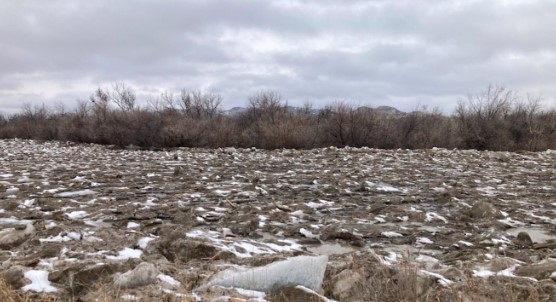
The CSU Hydraulics Laboratory has strong capabilities to investigate ice-affected river processes through a combination of physical modeling, field measurements, and numerical simulations. The lab has capacity to conduct investigations of flow-ice-sediment interactions using high-resolution instrumentation including particle image velocimetry (PIV), acoustic Doppler velocimeters (ADV), and laser-based surface profiling. These tools allow researchers to study the hydraulic conditions under which ice forms, moves, and interacts with sediment and large wood, particularly during ice jam events or breakup floods.
In the field, CSU researchers study ice-affected rivers using drone-based imagery, time-lapse cameras, water temperature loggers, and acoustic Doppler current profilers (ADCPs) to monitor ice formation, breakup, and associated flow and sediment dynamics. These datasets are integrated with 2D hydraulic models and energy balance calculations to better understand the timing and consequences of ice-related processes in natural systems. Ongoing work includes the study of ice jams in plains rivers, anchor ice formation in steep headwater streams, and the influence of post-fire snowmelt on winter ice dynamics.